
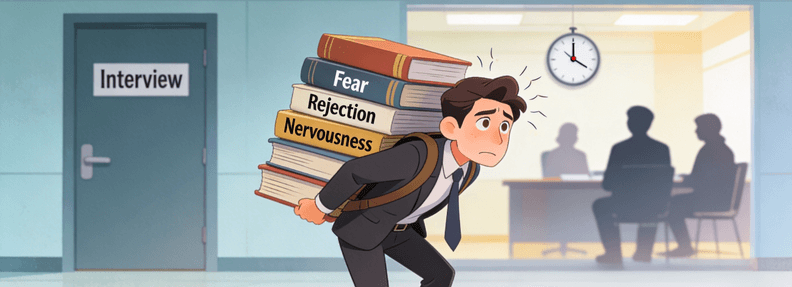
Managing interview anxiety professionally
Handled well, a certain level of nervousness can actually sharpen focus and presence.
Table of contents
Why interview anxiety happens
Interview anxiety usually comes from uncertainty — not from lack of ability. Common triggers include:
- Fear of being judged
- Pressure to perform perfectly
- Past negative interview experiences
- High expectations tied to the role
Understanding that anxiety is a natural response to importance helps normalize it rather than fight it.
How anxiety shows up during interviews
Anxiety can appear in subtle ways:
- Rushing through answers
- Overexplaining or underexplaining
- Losing track of the question
- Difficulty recalling prepared examples
Recognizing these patterns helps you intervene early instead of letting anxiety take control.
Practical ways to manage anxiety before and during interviews
Before the interview:
- Prepare key examples rather than full answers
- Practice explaining ideas out loud
- Get clarity on logistics to avoid last-minute stress
During the interview:
- Pause briefly before answering — it shows thoughtfulness
- Ask for clarification if needed
- Take a sip of water to reset your pace
These small actions help you regain control without drawing attention.
Turning nervous energy into composure
Anxiety often comes from caring about the outcome. Instead of suppressing it, redirect it:
- Use nervous energy to stay alert and engaged
- Focus on having a conversation, not delivering a performance
- Remind yourself that interviews are two-way evaluations
Composure comes from preparation and perspective, not perfection.
Looking ahead
Managing interview anxiety professionally is a skill that improves with practice. Each interview becomes easier when you focus on clarity, presence, and communication rather than fear.
If you’re preparing for interviews and want to approach them with confidence and balance, Naukrigulf can help you explore opportunities where your strengths and experience are the right fit.
Related articles
Is your notice period hurting your job search?
You have the right experience.The job matches your skills.The interviewer is interested.Then comes one question:“How soon can you join?”You say two or three months, and suddenly th...
Read more
What should you do if your job search isn't working?
You have applied for dozens of jobs.Your CV is ready. Your profile is updated. You keep finding new openings and applying.But the interviews are not coming.Before sending another a...
Read more
How to talk about a short stint on your CV?
A role that lasted six or eight months on a CV is not the red flag most candidates fear it is. What makes it a problem is not the duration. It is how you handle it.Hiring managers ...
Read more