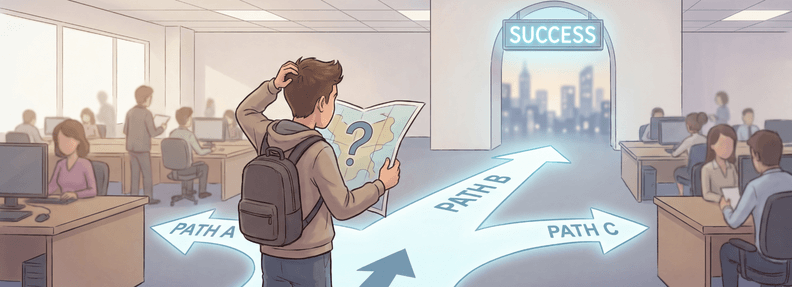
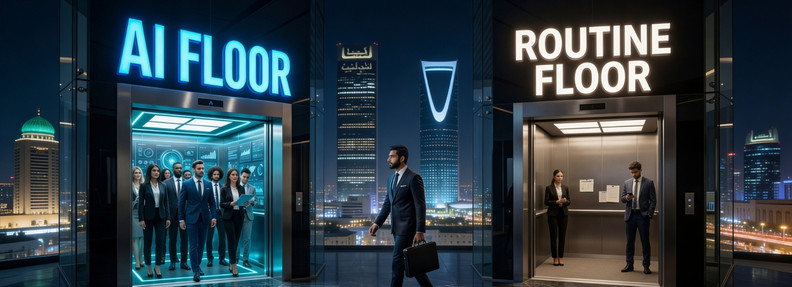
Saudi Arabia just declared 2026 the Year of AI. Is your career keeping up?
This is not just an individual shift — it is a structural one. In March 2026, the Saudi Cabinet officially designated 2026 as the Year of AI, backed by the SAMAI programme which has already trained over one million citizens in foundational AI skills. When a government moves that decisively, the signal to professionals is clear: adaptation is no longer optional. It is the baseline expectation.
The difference between panic and paying attention
Adapting to change is not about reacting the moment something feels uncertain. It is about paying attention early enough that you are never caught off guard. The professionals who navigate this best are rarely the ones who were formally told their role was changing — they were already watching, already asking questions, already moving.
Before anything else, ask yourself three honest questions:
- Which parts of my role are being handled faster or differently than they were twelve months ago?
- Which parts of my work genuinely still need me — my judgement, my relationships, my instincts?
- Am I learning enough about what is changing around me to have an informed conversation about it?
Your answers will tell you whether you need to adjust your skills, reframe how you present your value, or start thinking about where your role is heading in the next two to three years.
What adapting actually looks like
Adapting is not about becoming a technology expert overnight. It is about understanding enough of what is changing in your industry to stay relevant within it — and doubling down on the parts of your work that cannot be automated.
Judgement, relationships, communication, and the ability to navigate complexity — these are not soft skills. In a landscape where routine tasks are increasingly handled by machines, they are your most valuable professional assets. The professionals who adapt well are the ones who recognise this and lean into it deliberately, while staying curious enough about the technology reshaping their field to work alongside it rather than around it.
The timing is everything
Here is what most people miss: adapting early is not just about protecting your position. It is a career decision with real consequences for where you end up.
The professionals who moved ahead of the change — who upskilled before they were asked to, who reframed their roles before their organisations did it for them — did not just survive the transition. They became indispensable during it. They got visibility, responsibility, and opportunities that the professionals who waited simply did not.
Moving early puts you in front of the change rather than behind it. That distinction matters more than most people realise until it is too late to act on it.
What early adaptation is actually worth
According to PwC's 2026 Global AI Jobs Barometer, professionals with AI skills command a 56% wage premium over peers in equivalent roles without those skills. In sectors most impacted by AI, wages are growing at twice the rate compared to less exposed industries. That is not a marginal difference. That is the gap between two professionals doing similar work in the same sector — where one chose to adapt and one chose to wait.
That premium is not theoretical. Across the Gulf, governments and employers are actively investing in AI-literate talent — and rewarding it. Professionals who treat this window as an opportunity rather than a threat are positioning themselves not just for job security, but for the kind of career acceleration that comes when demand outpaces supply.
That window is still open. The question is whether you are walking through it.
Need to think bigger about your next move? Here is your transition guide → Your role is being automated. Here is what to do next.
Related articles
First 6 months at work: mistakes to avoid
The first six months in a role are a learning phase, but they are also a visibility phase. While mistakes are expected, certain patterns can slow progress or create unnecessary cha...
Read more
Does hustle actually accelerate your career?
In many workplaces, the employees who work the longest hours are often seen as the most committed.They stay late, volunteer for additional responsibilities, and rarely decline new ...
Read more
Career planning mistakes to avoid early on
Early career decisions often happen quickly—sometimes driven by urgency, sometimes by opportunity. While there is no perfect roadmap, certain planning mistakes can quietly slow pro...
Read more