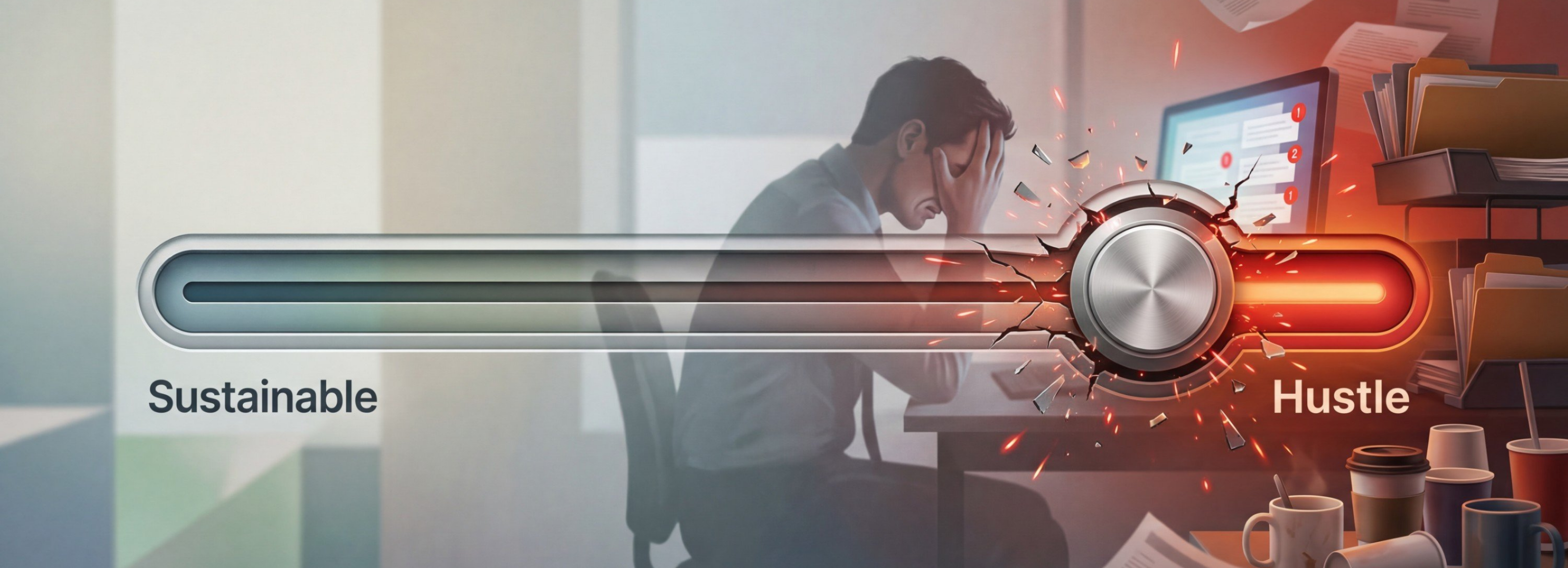
The shift from hustle to sustainable performance
Working longer hours, moving faster, and pushing teams harder often helped organizations deliver results in high-growth phases.
But today, many companies are beginning to question whether this approach can sustain performance over time.
Because the nature of work — and the expectations of the workforce — are changing.
Table of contents
- Why hustle worked before
- Why it’s no longer enough
- What sustainable performance looks like
- What companies need to rethink
Why hustle worked before
In earlier growth stages, speed often mattered more than structure.
Lean teams, aggressive timelines, and rapid expansion created environments where extra effort filled the gaps. Employees stepping in, working longer, and taking on more responsibility helped organizations move forward quickly.
Why it’s no longer enough
Today’s workplace looks different.
More professionals are prioritizing sustainable growth, clarity in work, and long-term performance over constant pressure. The next generation entering the workforce is even more aware of burnout and increasingly values balance alongside ambition.
As Gen Z professionals move into leadership roles over the next decade, these expectations will begin to shape how organizations operate.
Companies that continue to rely only on hustle may find it harder to attract, retain, and develop strong talent.
What sustainable performance looks like
Sustainable performance is not about reducing effort — it’s about directing it more effectively.
It shows up in focused execution, clear priorities, and consistent output over time. Teams operate with better clarity, make stronger decisions, and maintain performance without constant pressure.
Instead of relying on individuals to stretch beyond capacity, the system itself supports better work.
What companies need to rethink
Shifting away from hustle requires intentional change.
Organizations need to look at how work is structured, how performance is measured, and how teams are supported over time.
Clear priorities, realistic workloads, and a focus on outcomes help create environments where employees can perform consistently without burning out.
Because in the long run, performance is not defined by how much effort teams can sustain in the short term.
It is defined by how effectively they can perform over time.
If you're looking to build teams that can deliver consistently in a changing workplace, finding the right talent is the first step. You can start hiring qualified candidates on Naukrigulf to connect with professionals ready to grow with your organization.
Related articles
Qatar Hiring Index - April to May 2026
Hiring patterns continue to evolve across Qatar as businesses build on the country's steady economic momentum and sectoral growth. The inaugural Naukrigulf Hiring Index (Qatar) pro...
Read more
UAE Hiring Index - April to May 2026
Hiring patterns are constantly evolving and understanding them requires more than headline numbers. The inaugural Naukrigulf Hiring Index (UAE) provides a clear view of employer hi...
Read more
Oman Hiring Index - April to May 2026
Hiring patterns continue to evolve across Oman as businesses adapt to changing market dynamics and sector-specific opportunities. The inaugural Naukrigulf Hiring Index (Oman) provi...
Read more