
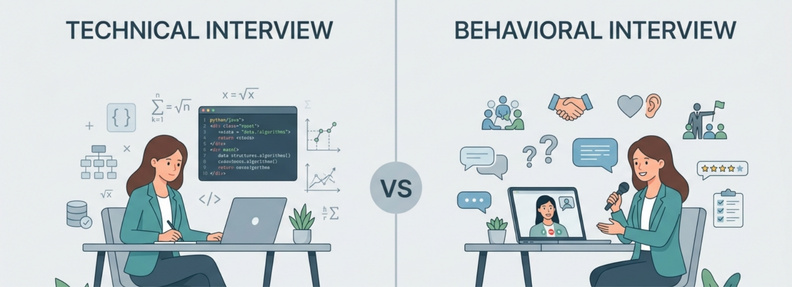
How to ace both technical and behavioral interviews
Each format tests a different dimension of your suitability for the role.
Table of contents
- Why companies use different interview formats
- What technical interviews really evaluate
- What behavioral interviews are designed to reveal
- How to prepare for both without overpreparing
Why companies use different interview formats
Hiring decisions involve more than checking qualifications. Employers want to assess:
- Whether you can do the job
- How you approach problems
- How you work with others under real conditions
Technical interviews focus on capability, while behavioral interviews focus on application and judgment. Together, they provide a fuller picture of how you might perform once hired.
What technical interviews really evaluate
Technical interviews are not just about correct answers. They are used to understand:
- Your problem-solving approach
- How you explain complex ideas
- How you handle uncertainty or gaps in knowledge
Even when you don’t know an answer fully, showing structured thinking and clarity often matters more than perfection. Interviewers are paying attention to how you arrive at conclusions.
What behavioral interviews are designed to reveal
Behavioral interviews explore how you act in real situations. Common themes include:
- Handling challenges or conflict
- Working under pressure
- Taking responsibility or initiative
- Learning from mistakes
Strong behavioral answers are specific and honest. They show awareness of context, action, and outcome — not just success stories.
These interviews help employers assess reliability, adaptability, and alignment with team expectations.
How to prepare for both without overpreparing
To prepare effectively:
- Review key technical concepts relevant to the role
- Reflect on real experiences you can reference across multiple questions
- Practice explaining your thinking clearly, not just your results
Avoid trying to memorise answers. Preparation should give you structure, not restrict authenticity.
Looking Ahead
Handling both technical and behavioral interviews well comes down to balance. When you combine capability with self-awareness and clear communication, interviews become conversations rather than tests.
If you’re preparing for multi-stage interview processes and exploring roles aligned with your experience, Naukrigulf can help you discover opportunities where both your skills and approach are valued.
Related articles
Is your notice period hurting your job search?
You have the right experience.The job matches your skills.The interviewer is interested.Then comes one question:“How soon can you join?”You say two or three months, and suddenly th...
Read more
What should you do if your job search isn't working?
You have applied for dozens of jobs.Your CV is ready. Your profile is updated. You keep finding new openings and applying.But the interviews are not coming.Before sending another a...
Read more
How to talk about a short stint on your CV?
A role that lasted six or eight months on a CV is not the red flag most candidates fear it is. What makes it a problem is not the duration. It is how you handle it.Hiring managers ...
Read more